
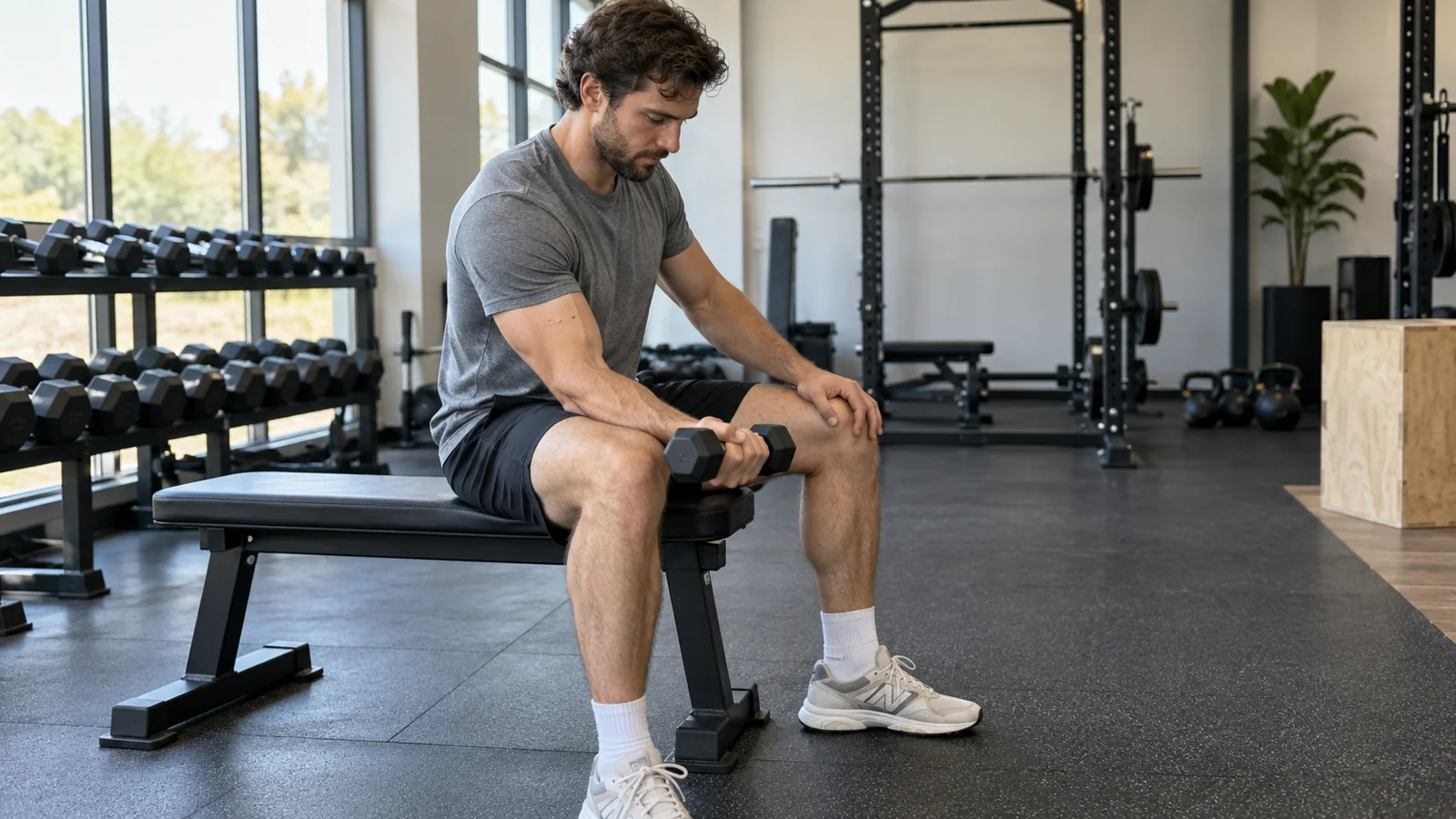
A dumbbell wrist curl trains wrist flexion: with your forearm supported and palm facing up, bend your wrist to lift a light dumbbell, then lower it under control. Keep your elbow and forearm still, use a comfortable range, and start much lighter than you would for a biceps curl. The movement belongs at the wrist, not the elbow.
Published October 18, 2026.
This guide focuses on the supported, palm-up dumbbell version for general fitness. It explains how to position the support, choose resistance, distinguish wrist curls from other arm exercises, and add a small amount of direct forearm work without overwhelming a routine that already includes gripping. It is not a rehabilitation plan for a painful wrist or elbow.
What does a dumbbell wrist curl work?
The exercise challenges the muscles that bend the palm toward the inner forearm. These wrist flexors are located largely in the forearm, even though the visible movement occurs at the wrist. Holding the handle also involves the fingers and thumb. A supported wrist curl therefore has a different purpose from an exercise in which you bend your elbow to bring a dumbbell toward your shoulder.
That distinction matters when choosing an exercise. A biceps curl primarily involves elbow flexion; a wrist curl involves wrist flexion. During a wrist curl, you should not need to lift the whole forearm off its support. If your elbow repeatedly bends and the weight moves toward your chest, you have changed the task rather than discovered a more powerful wrist-curl technique.
The American Academy of Orthopaedic Surgeons explains that several muscles involved in wrist and finger flexion attach through tendons near the inside of the elbow. This anatomy helps explain why forearm training can be felt beyond the wrist itself. It does not mean elbow pain during wrist curls is normal or that doing more repetitions will treat it.
Wrist strength is not the same as every kind of grip strength
Wrist curls can be one piece of forearm training, but gripping is not a single ability. Holding a grocery bag, pinching an object, supporting a barbell, and controlling a racquet ask different things of your hands and arms. Do not assume that improving one exercise guarantees equal improvement in every task. Practice the relevant activity, and use accessories to support it.
Likewise, visible forearm development depends on more than choosing the right curl. Consistent training, overall workload, recovery, and individual differences all matter. There is no reliable promise that a particular number of wrist curls will create a particular change in circumference. Judge early progress by better control and repeatable performance before judging it by appearance.
Equipment and setup: make the support do its job
You need one light dumbbell, a stable seat, and a firm support for your forearm. A fixed table or bench can work. Your hand must clear the edge so that the wrist can move without the dumbbell striking the surface. Check that the seat cannot roll or slide when you reach for the weight.
A folded towel can soften a hard edge, but avoid a thick, unstable cushion that lets your forearm rock. Place the towel where the forearm rests, leaving the wrist joint free to move. If the support presses uncomfortably into a small spot, reposition it before adding resistance. Padding should improve comfort without changing the exercise into a balancing problem.
Start with one arm at a time. This makes it easier to set the dumbbell down safely and notice whether the working forearm stays still. It also gives your free hand a practical role during setup. You do not need matching effort between both arms at every moment or a two-dumbbell variation to make the exercise worthwhile.
Table support versus thigh support
A table makes forearm movement easier to spot because the support does not move with your leg. Adjust your chair position until you can rest the forearm without lifting your shoulder. If the table is too high and forces you to shrug, choose another surface rather than accepting a strained posture for the sake of convenience.
Thigh support is useful when no suitable table is available. Sit with your feet planted, rest the forearm along the thigh, and let the hand extend just beyond the knee. Keep the leg still. A towel can improve comfort, but the hand should remain free. Avoid pushing your thigh upward to help finish difficult repetitions.
Neither setup is inherently more advanced. Choose the one that lets you keep a quiet forearm and a relaxed shoulder. If you switch between them, record the change. The angle of the forearm and the amount of support can affect how the same dumbbell feels, so comparisons are clearest when the setup stays consistent.
How to do a dumbbell wrist curl, step by step
- Sit securely. Plant your feet and arrange the dumbbell within easy reach. Keep the surrounding floor clear so you can put it down without twisting awkwardly.
- Support the forearm. Place it palm-up on the table, bench, or thigh. Begin with a comfortably bent elbow and the hand just beyond the support.
- Hold the handle securely. Wrap your thumb around the dumbbell and keep the handle settled in your palm. You do not need a maximal squeeze.
- Find a comfortable starting position. Let the wrist move slightly downward if that feels comfortable. Do not allow the weight to pull it into a forced stretch.
- Curl through the wrist. Bring the palm toward the inner forearm while the elbow and forearm remain still. Stop before the movement becomes cramped or painful.
- Lower smoothly. Return through the same comfortable range. Keep control instead of letting gravity drop the weight.
- Finish deliberately. Use your free hand to help secure the dumbbell before setting it down. Change sides and recreate the same support.
For learning, try a relaxed rise of about two seconds and a similar controlled lowering. This is an original coaching suggestion, not a claim that a particular tempo is optimal. A short pause can help you distinguish muscular control from momentum. Continue breathing normally instead of holding your breath throughout the set.
Institutional demonstrations also use supported wrist movement. For example, Royal Berkshire NHS Foundation Trust’s wrist-strengthening leaflet shows the wrist moving beyond a table edge and describes adding a light weight as appropriate. Its leaflet is intended for therapist-directed care; the general-fitness example here does not replace those individual instructions.
A useful five-repetition rehearsal
Before your first loaded set, perform five repetitions with an empty hand. Watch the back of your hand move relative to the forearm. Then repeat with the lightest suitable dumbbell. If the elbow begins helping immediately, or the hand moves sideways instead of curling, the resistance or setup needs adjustment before you add more repetitions.
Ask three questions: can I stop anywhere in the movement, can I lower at the same speed I intended, and can I keep my forearm supported? Three yes answers are more informative than a large weight label. A wrist curl has a small movement arc; it does not need to look dramatic to provide useful practice.
How heavy should the dumbbell be?
Choose the load by the movement you can perform, not by what you use for rows or curls. The wrist is performing a different action with different leverage. The appropriate starting weight may be very light. If your available dumbbell is too heavy to control, practice unloaded rather than trying to make up for the mismatch with momentum.
For a first session, select a weight that allows roughly eight to twelve controlled repetitions while leaving several more possible. This is a conservative trial range, not a mandatory strength standard. If eight is already a struggle, reduce resistance or do fewer repetitions. If twelve is easy, use the session to learn consistent technique before increasing anything.
Small absolute increases can be large relative increases. Moving from one unit of weight to two doubles the external load, whether the labels use pounds or kilograms. A rack with wide gaps between dumbbells may not provide a sensible next step. More repetitions within a modest range, or simply repeating the current workload, can be the better choice.
Do not let the dumbbell roll into your fingertips
Some lifters deliberately combine finger opening with wrist curls. That is a different variation with additional grip demands and a less secure hold. It is unnecessary for this beginner version. Keep the handle in your palm throughout the set so that you can focus on wrist movement and reduce the chance of losing the weight.
Similarly, there is no need to use a very thick handle, grip-fatiguing accessory, or improvised slippery object. These changes make holding the resistance more difficult without guaranteeing a better wrist-flexion exercise. Begin with a comfortable, ordinary dumbbell that you can control both during the movement and while placing it on the floor.
A small beginner wrist-curl program
The following is an original general-fitness starting template for an otherwise comfortable, healthy beginner. It is not copied from an injury-treatment protocol and does not claim to be the only effective dose. Keep it small enough that you can evaluate how it interacts with the rest of your training.
- Frequency: one or two nonconsecutive sessions per week to start.
- Practice: five unloaded repetitions per side, followed by a light rehearsal if needed.
- Working sets: one set per side initially; consider a second only after the first amount is well tolerated.
- Repetitions: about eight to twelve controlled repetitions per set.
- Rest: around a minute between sets, or longer if needed to restore control.
- Effort: finish before you need help from the elbow, shoulder, or supporting leg.
Your first few sessions are information gathering. Record how the wrist feels during the exercise, whether the forearm becomes unusually sore later, and whether ordinary gripping feels normal the next day. There is no benefit to making the first workout so demanding that you cannot tell whether the exercise itself or the amount was the problem.
If you already climb, play a racquet sport, do substantial manual work, or perform many pulling exercises, begin at the lower end. Your forearms do not start with an empty workload just because wrist curls are new. Direct accessory work should fit around those demands rather than compete with them.
Progress over sessions, not by forcing a weekly increase
First, make the range repeatable
Use the same support, grip, and comfortable endpoints. Try to make the last repetition resemble the first. If the range shrinks as you tire, end the set there. Counting extra partial movements as identical repetitions makes the log look better while making it less useful for deciding what to do next.
Then, add a repetition when it fits
Suppose you perform eight comfortable repetitions on each side and feel normal afterward. At the next session, try nine with the same dumbbell. If the ninth repetition needs an elbow lift, stop at eight. The target is an invitation to test your current ability, not an obligation to complete a number at any cost.
Increase resistance only when the next step is practical
After you can repeat the top of your chosen range comfortably across several sessions, consider the smallest available increase. Return toward the lower end of the repetition range when the weight rises. If the next dumbbell is too large a jump, stay where you are. You can use double progression without assuming every equipment rack offers useful increments.
Change one variable at a time
Do not add weight, sets, and a third weekly session together. If your wrists become uncomfortable afterward, you will not know which change mattered. A single adjustment makes the response easier to interpret. Repeating a successful workload is also a valid decision, especially when another part of your routine has become more demanding.
Common mistakes and practical fixes
The forearm lifts off the support
Reduce the weight and check the support height. A support that sits too low can encourage leaning, while a heavy dumbbell encourages help from the elbow. Rehearse with an empty hand. You can lightly place your free hand on the working forearm as a reminder, without pressing hard or forcing the joint into position.
The wrist drops quickly at the bottom
Stop the set and choose less resistance. The lowering phase is part of the repetition, not a reset that can be skipped. You should be able to control the direction change without a jerk. Avoid chasing a deeper stretch when you already cannot manage the current range.
The hand bends toward the thumb or little finger
Recheck your forearm alignment and center the handle in your palm. The main movement should be the palm curling toward the forearm, rather than the dumbbell tipping sideways. A small natural variation is not a reason to panic, but repeatedly losing direction is a reason to lighten the load or get coaching.
You squeeze so hard that the grip becomes the entire workout
Use enough pressure to keep the dumbbell secure, then focus on the wrist. If the handle feels slippery, dry your hands and check the equipment. Do not compensate by turning every repetition into a maximal crushing effort. If gripping itself is your target, train it deliberately in a separate exercise.
You use soreness as the progression rule
A strong burning sensation or next-day soreness does not tell you that the dose was ideal. Progress requires repeatable training, and excessive soreness can interfere with the very activities you want to improve. If normal tasks are affected, reduce the next exposure rather than treating discomfort as evidence that you should repeat the same amount.
Wrist curl, reverse wrist curl, and hammer curl: different jobs
A palm-up wrist curl trains wrist flexion. A reverse wrist curl uses a palm-down position to train wrist extension. A hammer curl bends the elbow with a neutral grip. These movements are related through the forearm, but they are not interchangeable and should not automatically use the same dumbbell weight.
If you add wrist extension, learn it separately with an appropriately light load. Do not assume that matching the flexion load or repetition count is necessary for balance. Individual strength and comfort differ between movements. A small amount of both can be an option, but no beginner needs a long menu of forearm accessories immediately.
Workit’s hammer-curl guide covers the elbow-bending exercise. Use it when that is the movement you want to train. Wrist curls make more sense when your specific aim is controlled wrist flexion and you have room for that accessory work after your main exercises.
Where wrist curls belong in a workout
For most general strength sessions, place demanding wrist curls after exercises that depend heavily on a secure grip. Fatiguing your forearms before rows, carries, or pull-ups can make grip the limiting factor earlier than intended. If learning wrist curls is the main purpose of the session, a very light practice set earlier can still be reasonable.
One simple arrangement is your usual full-body workout followed by one supported set per side. Do not add a complete forearm circuit merely because the dumbbell is already available. A small addition is easier to recover from and easier to remove if it proves unnecessary. The exercise-order guide explains how to put your main priorities first.
Log the support used, dumbbell weight, repetitions on each side, and any meaningful comfort note. “Table support, light dumbbell, ten each, controlled lowering” is more useful than “arms finished.” If one side needs less resistance, record that honestly rather than forcing symmetry. A persistent or sudden difference accompanied by symptoms deserves individual assessment.
When to stop or get individual advice
Stop for sharp pain, worsening joint pain, tingling, numbness, or an unexpected loss of grip. Do not work through those symptoms to complete the planned set. Persistent symptoms, a recent injury or surgery, or a diagnosed hand, wrist, or elbow condition call for guidance from an appropriate clinician before following a general exercise plan.
The AAOS therapeutic exercise program for epicondylitis includes staged wrist-flexion work, but that is condition-specific material. Its frequency and progression should not be borrowed as a universal bodybuilding routine. If you have been given a rehabilitation program, follow the treating professional’s instructions rather than combining it with extra sets from this article.
Dumbbell wrist curl FAQs
Can I do wrist curls every day?
Daily hard sets are unnecessary for a beginner. Start with spaced sessions and account for other gripping activities. Gentle unloaded movement and challenging strength work are different exposures. A medical program may use a different schedule for a specific reason; that does not make daily loaded curls the default for everyone.
Should I use one dumbbell or two?
One dumbbell is enough. Training one side at a time makes support, control, and safe setup simpler. Two can save time when both forearms have secure support and you already know the movement. There is no requirement to progress to two simultaneous dumbbells.
Will wrist curls make my wrists bigger?
They train muscles in the forearm, but they do not guarantee a larger wrist measurement or change your underlying bone structure. If appearance is your goal, judge changes over time within a balanced strength routine rather than expecting a small isolation exercise to reshape a joint.
Are wrist curls necessary if I already lift weights?
No. Many routines involve substantial gripping without direct wrist curls. Add them for a clear reason, such as wanting specific wrist-flexion practice, and evaluate whether they help. An accessory exercise earns its place by fitting your goals and recovery, not by being mandatory.
Keep the exercise small, controlled, and repeatable
If you are also learning a light upper-body band accessory, see the resistance-band pull-apart guide. Its shoulder movement is different from a wrist curl; each needs its own comfortable resistance and setup.
A useful dumbbell wrist curl starts with stable support and ends before the elbow has to take over. Begin light, keep the handle secure, and increase only what you can recover from. Explore workout programs and fitness challenges with Workit.